Stories
América Latina y el Caribe
31-05-2023
“It is not a question of numbers, but of having the same opportunities”: This is how we experienced the 6th Women's Forum
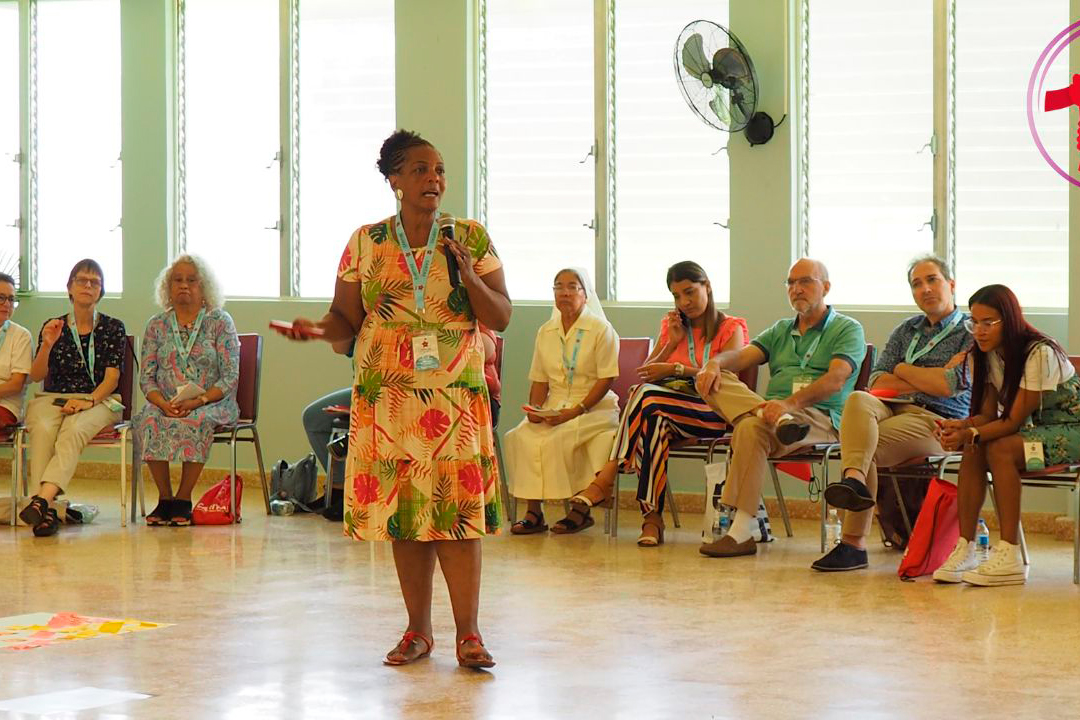
Women who meet again, listen to each other and discern together from that listening. That was the purpose of the 6th Women's Forum, held on May 29 and 30 in Aguas Buenas (Puerto Rico) as a preliminary step to the XX Latin American and Caribbean Congress of Cáritas. Women who in this reflection have highlighted some elements, such as caring for the lives of women, inclusion, incorporating the feminine in pastoral and theology, recognizing and empowering women, or the role of women in synodality.
Contribution of Cáritas in the advancement of female leadership The leadership and participation of women is an important element in this path, as highlighted by Martha Rubiano Skretteberg, general director of Caritas Norway and coordinator of the Women's Committee of Caritas International. This advance in female leadership and participation is a work of decades, in which Latin America and the Caribbean has been an example when it comes to women having assumed responsible roles in decision-making in Cáritas.
In recent years, the importance of Pope Francis' political decision to give responsibility to women in decision-making in the Church has been highlighted, seeking to involve them in decision-making spaces. Something that has theological foundations, he insisted, even though this has not been the case historically, with structures that have limited that role. For Martha Skretterberg, “it is not a question of numbers, but of having the same opportunities”, for which a new culture is necessary, one that leads men and women to work together, and for education to create that equality from childhood.
Along with this, she highlighted that inequality leads us to social injustice, showing that statistics show that the majority of the poorest are women. Peacebuilding is a space in which women have played a fundamental role, giving as an example the peace process in Colombia, the country where she was born and raised. Finally, she called on the hierarchy of the Church to involve women in decision-making, something that must also be promoted in the political leadership in the different governments.
Care, health and violence Care, health and violence in relation to women, was the topic addressed by Ana Lucía Torres Castillo, Director of the Institute of Public Health of the Pontifical Catholic University of Ecuador (PUCE), addressing the unequal relationships between men and women, something that It has to do with the concepts of sex and gender, and that influences social organization, insisting that the problem is not the differences, but that these differences sustain a system of inequality, which is the field in which there is a lot of work to do.
To do this, care must be reorganized in work spaces, especially unpaid care, revaluing care as a shared task between the different members of the household. Care is a social risk, which is managed by the State, the market and the family, insisted the director of the Institute of Public Health of the PUCE, pointing out that in Latin America and the Caribbean it falls mainly on the family, where women contribute to a good part of the wealth of the countries, although this is not generally recognized.
Normalization of violence In relation to health, she addressed the field of health determinants, somewhat exacerbated during the COVID-19 pandemic, also in the field of mental health and everything that has to do with anxiety and depression, which is greater among women, which, according to Ana Lucía Torres, is determined by housing conditions, household chores and living with people who need care, among other elements. The normalization of violence is an increasingly present reality, which has to do with loving relationships, he highlighted.
The need for different lenses to see reality is a challenge, in the words of Torres Castillo, who advocated for the logic of solidarity for care, fair conditions for care spaces, thinking about conciliation mechanisms, recognizing what women do within the Church and around care, also in ecclesial spaces, resignifying care through joy and enjoyment. A critical look that helps to overcome asymmetrical and subjugating relationships is necessary, thus being able to help overcome all the social barriers that exist.
Reflections that have given way to sharing experiences that show the progress made in Latin America and the Caribbean in the participation of women in ecclesial and social decision-making spaces at different levels, from the most basic to spaces that have greater responsibility. Always knowing that it is a process and that progress does not always arrive at the speed expected, which makes us see that we continue to move forward in making new ecclesial and social dynamics a reality, thus concretizing a synodality that helps make spaces of transformation a reality. A journey to which this 6th Women's Forum will undoubtedly contribute its grain of sand, of which one more example is the “You will not be silent” Campaign. |
Democracy, human rights and peace building