En Perú, más de 8 mil nativos de pueblos originarios son sensibilizados y tienen acceso a la vacunación gracias a Cáritas y CRS
La pandemia del COVID -19 y sus medidas de contención, como el proceso de vacunación a la población peruana, han generado nuevas dinámicas en la sociedad, tanto en sus propias prácticas como en el manejo de la información.
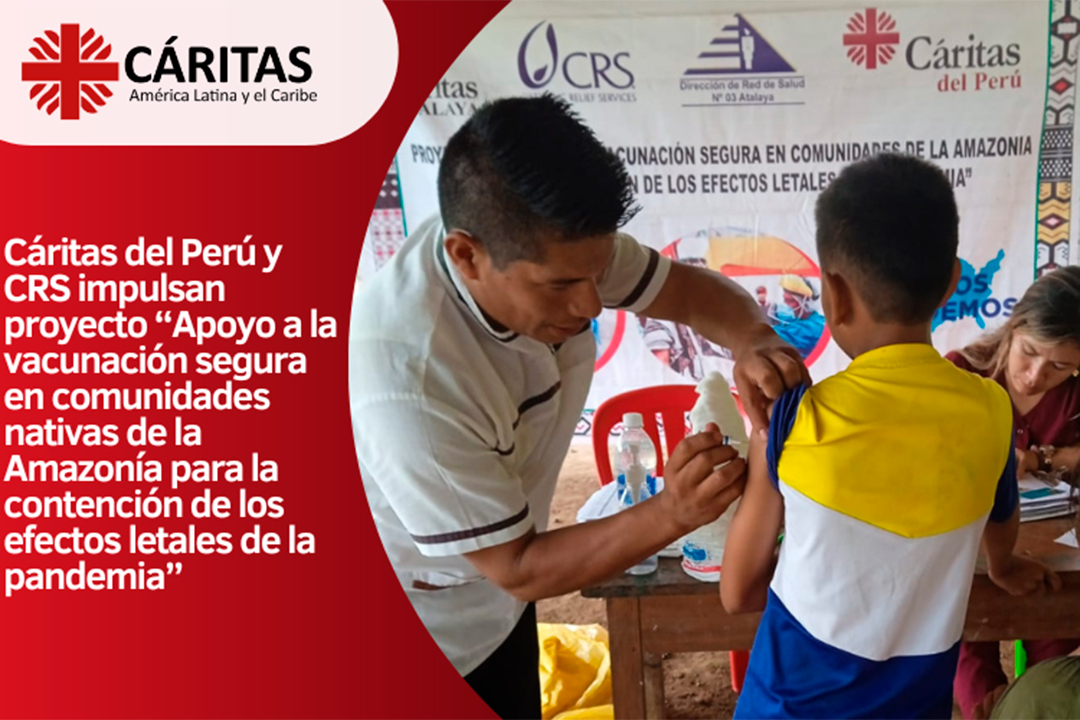
Ante este panorama, Cáritas del Perú junto a las Cáritas Diocesanas de Yurimaguas, Atalaya y Pastoral Social de Jaén, con el apoyo de Catholic Relief Services -CRS llevan adelante el proyecto “Apoyo a la vacunación segura en comunidades nativas de la Amazonía en 4 departamentos (Loreto, Junín, Ucayali y Amazonas) para la contención de los efectos letales de la pandemia”.
Este proyecto se desarrolla en 81 comunidades nativas de los 4 departamentos, participando 8,141 personas entre adultos mayores, adultos, adolescentes y niños de las etnias Achuar, Ashéninka, Asháninka, Yine, Candoshi, Chayhuita, Kichwa, Qichua, Shawi, Wampis y Awajún, pertenecientes a 32 Federaciones Indígenas.
Según el informe desarrollado por Cáritas del Perú, el porcentaje de personas preocupadas por los efectos adversos de la vacuna del COVID -19, disminuyó de un 63% a 20%, esto como resultado de los talleres informativos a pobladores de comunidades nativas, talleres de fortalecimiento con agentes comunitarios de salud, entrega de kits de protección e higiene y talleres de capacitación al personal de salud, los mismos que fueron presenciales y virtuales con la participación de representantes del Ministerio de Salud, Redes, Microredes y establecimientos del primer nivel de atención.
Mirella Maquera Vidangos, coordinadora del proyecto, comentó que la metodología de capacitación se realizó comunidad por comunidad, con el apoyo de traductores contratados con fondos del proyecto, personal del equipo (bilingüe) y agentes comunitarios de salud, los cuales son actores claves reconocidos en sus comunidades, llevando información clara y precisa sobre la vacunación segura y efectos atribuidos a ella, a los miembros de las comunidades.
Respecto a las campañas masivas de comunicación en materia de prevención del COVID-19, a la fecha, se han implementado 3 campañas a través de distintos canales de comunicación difundiendo 12 mensajes sobre la vacunación segura y eficaz; en forma responsable y culturalmente apropiada en 7 lenguas originarias (Awajún, Ashaninka, Asheninka, Yine, Matsigenka, Kandozi y Kichwa), con el apoyo de traductores de la zona, entre ellos docentes de Centros Interétnicos, docentes de NOPOKI y colaboradores de las emisoras locales. Los canales de comunicación que vienen siendo utilizados son spots radiales en comunidades nativas con acceso a emisoras locales/ Internet, uso de parlantes/megáfonos, publicación de afiches y participación en programas radiales.
En cuanto al acceso a vacunación contra el COVID-19, se potenció la respuesta del sector salud en vacunación, administrando 6,786 dosis; de las cuales 2,153 corresponden a la primera dosis, 1,722 a la segunda, 2,402 la tercera y 509 a la cuarta dosis. Ello es resultado de reuniones periódicas, cartas cursadas al sector salud para el anuncio de todas las acciones del proyecto y formación de brigadas para las jornadas de vacunación a niños, adolescentes, adultos, adultos mayores y personas con comorbilidades.
La llegada del proyecto a la zona de intervención ha motivado un proceso de vacunación informado y seguro, acercando el sector salud a la población en forma permanente.
Además, el proyecto ha implementado Mecanismos de Retroalimentación de Quejas y Respuestas (MRQR) para la ejecución de actividades de una manera segura y digna, así como un Sistema de Monitoreo y Evaluación (MEAL) que permite analizar de manera continua los resultados esperados.
NDP: Cáritas del Perú |
Care of the common home and Holistic Human Development