Stories
América Latina y el Caribe
12-11-2025
"Before I loved the sound of rain. Now every drop scares me"
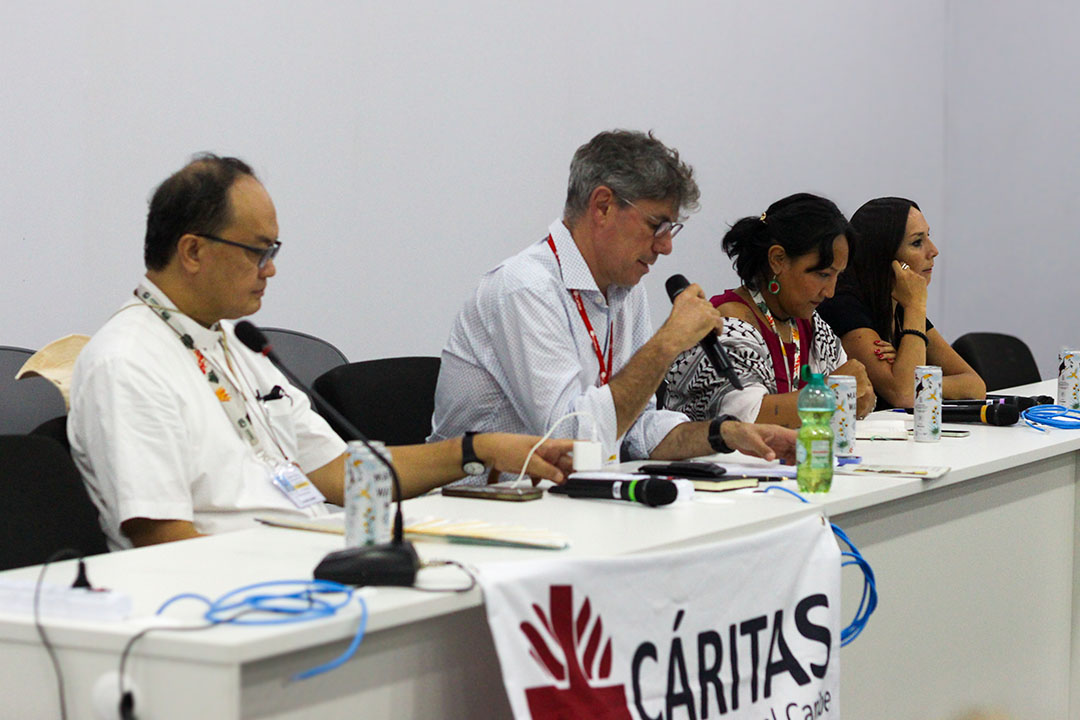
“Before I loved the sound of rain. Now every drop scares me.” The voice of Joy Reyes, climate justice activist and survivor of Super Typhoon Haiyan in the Philippines, resonated in Room 5 of side events in Belém.
Her words set the tone for a rich debate organized by Caritas Internationalis at COP30, in which testimonies from Asia and Latin America made one message clear: States must stop treating climate finance as charity and start treating it as justice.
The event, “The Moral Imperative of Climate Finance: Tackling Green Debt in a Jubilee Year," was co-organized with CAFOD, Catholic Relief Services (CRS), the Debt and Climate Task Force and Living Laudato Si' Philippines.
Alistair Dutton, Secretary General of Caritas Internationalis and moderator of the panel, captured the urgency from the beginning: "We are in the land of the Amazon, the lungs of the Earth. Some have enjoyed the benefits of development, but others have footed the bill. Justice demands that those who "Reyes' testimony based those words on his lived experience. He recalled the night in 2013 when Haiyan's winds devastated his hometown, forcing his family to flee the rising waters. "I loved the sound of the rain," he said. “Now every drop scares me.”
Voices of climate change survivors
His voice shook slightly as he added: “Resilience is not justice. We don't want to be resilient. We are not asking for mercy. We demand responsibility. Reyes transformed the dry vocabulary of climate finance—figures and promises—into a vivid human story, describing how he took his grandparents upstairs when waters flooded their home.
Bishop Pablo Virgilio David, president of the Catholic Bishops' Conference of the Philippines, spoke about the devastating effects of the recurring cyclones and typhoons that hit his country. “A rotating engine of ocean heat covering hundreds of kilometers, capable of erasing entire coastlines overnight,” he said. “To those who still deny the effects of climate change, I kindly invite you to live with us for a year in the most disaster-prone country in the world.”
He called for a move from loans to restitution, pointing to the serious imbalance that occurred in 2022, when developing countries paid off $59 billion in debt while only receiving $28 billion in private climate finance, most of it in the form of loans.
From Latin America, Carola Micaela Mejía, Bolivian economist and coordinator of Climate Justice at LATINDADD, framed the issue in political and structural terms. "Debt is a neocolonial instrument," he stated. “It keeps nations dependent, even as they face climate destruction on the front lines.”
Mejía cited data showing that Latin America spends three times more on debt service than on health and education, and that countries like Colombia allocate more than 20% of their public budgets to debt repayment and less than 1% to climate action. He called for a United Nations framework for sovereign debt resolution, arguing that "the power to decide should not remain in the hands of those who contributed to creating the crisis."
The moral demand that was repeated throughout the event was clear and simple: those who polluted the most must repair the most. Bishop David outlined a Mindanao pastoral proposal, a “land tariff,” which requires fossil fuel extractors to make mandatory contributions at the point of extraction. "This is not a compensation or a legal loophole," he stated, "but rather a reparative obligation."
Reyes once again highlighted the insufficiency of current efforts. "Financing for loss and damage amounts to only $700 million, an insignificant amount for what is needed," he said.
"For fourteen years, no country has been held accountable for failing to fulfill the promise of $100 billion. Why do victims have to take out loans to rebuild what others destroyed?"
Lucas D'Ávila, national coordinator for Environment, Risk and Emergency Management from Cáritas Brazil, shared the conclusions of an interregional study carried out in fourteen territories. "Poverty and climate vulnerability are two sides of the same coin," he stated.
In Brazil, 80% of families are in debt and social spending is reduced by interest payments. However, communities are not standing idly by.
He described the solidarity financing groups, seed houses and community banks that support thousands of people throughout the region. «Each branch of the river has its own reality. Each community has its own way of thinking and acting. There is a need to consult.”
Scotland's involvement in loss and damage programs
Gillian Martin, MP and Cabinet Secretary for Climate Action and Energy, highlighted Scotland's leadership in achieving real climate justice beyond promises. He noted that Prime Minister John Swinney has urged ministers to engage directly with East African communities benefiting from Scotland's climate justice and loss and damage programmes, following his visit to Zambia and Malawi. Martin stressed that Scotland sees climate finance as an investment in lives, not a gesture of charity, and called on larger economies to move from promises to practice, relying on local communities to design and boost their own resilient future.
To conclude the debate, speakers warned against “false solutions,” such as debt swaps, that allow business as usual while offering the illusion of progress. Mejía highlighted that less than 10% of adaptation funding reaches local actions and less than 1% goes directly to indigenous communities.
Everyone agreed that if local and indigenous communities were part of the decision-making process, this would not be the case. Representatives from many Caritas member organizations who attended the event renewed their commitment to continue fighting for debt justice and reparative climate finance.
By Susan Dabbous, Head of Editorial and Media, Caritas Internationalis and photos by Marcus Neto, Communications Coordinator, Caritas Latin America and the Caribbean
.jpg)
.jpg)
.jpg)
.jpg)
.jpg)
.jpg)
.jpg)
Care of the common home and Holistic Human Development